
Science Center
What Modern DNA Research Is Revealing About Klamath Lake AFA
Oct
Why the difference between AFA strains matters—and what modern genetics can tell us
For decades, Aphanizomenon flos-aquae (AFA) has been discussed in scientific literature as though it were a single, uniform organism.
Modern genetic research is giving us a much more detailed picture.
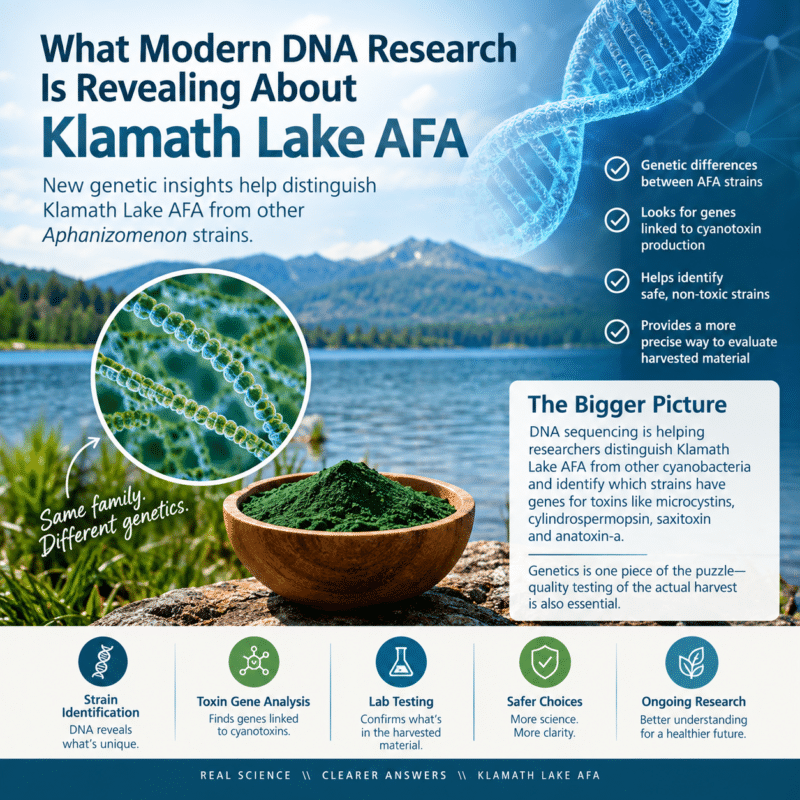
Using DNA sequencing, researchers can now distinguish between closely related cyanobacteria that may look similar under a microscope but can have very different genetic characteristics—including differences in genes associated with the production of cyanotoxins.
That distinction is particularly important when discussing AFA harvested from Oregon’s Upper Klamath Lake.
AFA Is Not Simply “One Thing”
The name Aphanizomenon flos-aquae describes a biological group, but organisms within this group are not necessarily genetically identical.
Think of it somewhat like different varieties of the same plant. They may share many characteristics, yet their genetics can differ in ways that affect important biological properties.
DNA sequencing gives researchers a much more precise way to identify those differences.
Recent comparative genomic research has examined large numbers of cyanobacterial genomes, including Klamath Lake AFA, and has demonstrated substantial genetic diversity within this broader group.
That matters because research involving one strain should not automatically be interpreted as applying to every organism that has historically been called AFA.
Why Scientists Are Looking at Toxin-Producing Genes
Some cyanobacteria possess genes that allow them to produce substances known as cyanotoxins.
Among the toxins of particular scientific interest are:
- Microcystins
- Cylindrospermopsin
- Saxitoxin
- Anatoxin-a
Genomic research provides scientists with a way to look for the genetic machinery associated with production of these compounds.
This is an important advance over treating all AFA as biologically identical.
Recent research has found toxin-associated genetic pathways in some cyanobacterial genomes while other strains lack those pathways. This helps explain why studies involving different organisms can sometimes produce very different results.
What About Klamath Lake AFA?
Klamath Lake AFA has been the subject of research and commercial use for decades.
Modern genomic analysis provides additional evidence that Klamath AFA can be genetically distinguished from other members of the broader Aphanizomenon group.
That is significant because it allows researchers to evaluate Klamath AFA based on its own genetic characteristics rather than simply applying findings from unrelated cyanobacteria.
Research specifically examining Klamath AFA has not identified the same toxin-associated genetic profile found in certain toxin-producing cyanobacteria.
But there is an important distinction.
Genetic identification is only one part of determining the safety of a harvested natural product.
A strain’s genome can tell researchers whether it possesses known genetic machinery associated with toxin production. It does not, by itself, tell us whether a particular harvested batch contains a contaminating organism or a measurable amount of toxin.
That’s why responsible AFA producers also rely on laboratory testing of harvested material and finished products.
Why Harvesting and Testing Matter
Upper Klamath Lake is a natural ecosystem. Multiple species of cyanobacteria can exist in the same environment.
The U.S. Food and Drug Administration has specifically noted the possibility of microcystin-producing Microcystiscontaminating harvested AFA. For this reason, testing for microcystins is an important part of quality control for AFA products.
This distinction is sometimes lost in discussions about AFA:
The genetic characteristics of the intended AFA strain and the quality of the final harvested product are two related—but separate—questions.
A modern safety program should address both.
What This Means for Consumers
For consumers, the most important takeaway is that the phrase “blue-green algae” doesn’t tell the entire scientific story.
The identity of the organism matters.
Its genetics matter.
The location where it is harvested matters.
And laboratory testing of the actual material matters.
Advances in DNA sequencing are helping researchers move beyond broad labels and examine cyanobacteria at a much more specific genetic level.
For Klamath Lake AFA, this provides another important piece of scientific information supporting the distinction between this material and toxin-producing cyanobacteria that may be discussed under similar names.
What About the Nutritional Research?
AFA is also being studied for its nutritional and naturally occurring compounds.
It contains proteins, pigments such as phycocyanin, amino acids and other biologically active compounds. Researchers have investigated several potential biological effects of these constituents.
Some human and laboratory studies have examined AFA in connection with immune-related activity and circulating CD34+ cells, among other areas of interest.
These findings are promising areas of research, but it is important to distinguish between a scientific observation and a proven medical benefit.
A study showing that a biological change occurred under specific conditions does not automatically establish that AFA prevents or treats a disease.
That distinction is important to us because good science requires both enthusiasm for new discoveries and honesty about what the evidence actually demonstrates.
A Better Way to Understand the Science
Perhaps the most important development is the ability to ask a much more precise question.
Instead of asking:
“Is AFA toxic?”
modern science allows researchers to ask:
“Which organism or strain are we talking about, what does its genome tell us, and what do laboratory tests show about the actual harvested material?”
That is a far more meaningful scientific question.
As DNA sequencing technology continues to improve, researchers can increasingly distinguish organisms that were previously grouped together and investigate their individual characteristics.
For Klamath Lake AFA, genomic research adds an important new dimension to decades of study, harvesting experience and laboratory quality control.
Science keeps getting more precise.
And when it comes to a natural product, that precision matters.
Klamath Lake AFA should be evaluated as the specific organism and harvested material it actually is—not simply according to findings about every cyanobacterium that happens to carry a similar name.
Non-Toxic Strain from Upper Klamath Lake
One of the most significant findings of this discovery is the confirmation that the AFA strain from Upper Klamath Lake, identified as AFA MDT14a, is incapable of producing harmful toxins such as cylindrospermopsin, microcystin, saxitoxin, or anatoxin-a.
This finding is important because it demonstrates that not all AFA strains have the same toxin-producing capabilities. The results specifically distinguish AFA MDT14a from toxin-producing cyanobacteria and provide scientific evidence regarding the characteristics of this particular strain.
Most importantly, these findings confirm that AFA MDT14a from Upper Klamath Lake is a non-toxin-producing strain, supporting its suitability as the source of AFA used in consumable products.
Scientific references and supporting research should always be considered when evaluating claims about dietary supplements. Klamath Lake AFA products should also be evaluated through appropriate quality-control and toxin testing.